
Divinity
Contents
Introduction
Excerpts from encyclopedia series “Ardea: Lore”, the tome “Divinity” by renowned scholar and explorer Joseph Alp.
I have spent twenty years studying gods, and I am no closer to understanding them than the farmer who prays for rain. The difference, I suppose, is that I take notes. What follows is the result of lengthy research into various faiths, customs, and beliefs of the continent of Ardea. It is worthy of note that the concept of worship and tradition among Ardean peoples is far from uniform. Some follow the more traditional precepts of religion, adhering to its commandments to the best of their abilities. Others follow gods who demand no such devotion, and their beliefs have adapted accordingly over time.
I must start, naturally, at the beginning. The beginning lies with Old Lux — or Luxaprimordiopolis, City of Primordial Light, as it is known in the old tongue. Though the records of the Divine Age are sparse and unreliable at best, there is sufficient evidence to suggest that Luxaprimordiopolis was, in fact, the first city ever to exist. Populated by gods and divine beings, it is described as a grand cyclopean structure of unparalleled beauty, floating in the clouds and basking in the sun's eternal glow. According to various records, the deities numbered in the thousands, and the complications of their family trees and politics are, I confess, beyond this scholar's humble mental faculties.
That is not to say that only gods inhabited the land. The people of that age — known within the academic community as the antebellodivinian people — lived side by side with their divine patrons and caretakers. I am saddened that the majority of records, written or otherwise, did not survive the events of the War in the Skies and the long age that followed. What can be extrapolated is that, with such close proximity to divinity, people lived longer, suffered fewer diseases, and were capable of extraordinary feats of magic — the likes of which are all but impossible to witness in our Current Age.
We do not know exactly what served as the catalyst for the war, what the sides were, or the number of casualties. We can only perceive its consequences, for it was, beyond the shadow of a doubt, the most devastating conflict Ardea has ever seen. The geographical changes alone were monumental — and I need not remind you of that blighted strip of land known as the Wastes of Desol. Should you, dear reader, wish to learn more, I direct you to my companion volume, Geography. Copies are available at any reputable bookseller.
Lyraen, The First Radiance

Lyraen and The Path Of Dawn
On principles
If one were to travel the breadth of Ardea asking common folk to name a god, the answer would, in the overwhelming majority of cases, be Lyraen. This is less a testament to his universality, if you will, and more a reflection of Aurelion's considerable size and evangelical enthusiasm. Nevertheless, credit where it is due: of all the deities I have encountered in my research, Lyraen's influence on the shape of the world is, by any measurable standard, the most profound.
The Path of Dawn — Aurelion's state religion, the primary vehicle through which Lyraen is worshiped and the one most likely to take issue with this chapter — presents him as the supreme creator deity, the First Radiance whose very gaze kindled the Sun and whose breath gave the world its form. A church that has had centuries to perfect its narrative is not to be dismissed lightly, and the faithful of Aurelion number in the millions. I will, therefore, present their account faithfully before offering my own modest observations.
On origins
If you, dear reader, are familiar with the official doctrine, then you might recognize the following:
“In the first hour there was only Darkness — endless and unseeing. Then Lyraen opened His eyes, and light became everything. From His gaze the Sun was kindled, and from His breath the world took form. All order flows from His light, all life is judged worthy or found wanting by His warmth, and that where Light endures, corruption recedes.”
It is a tidy theology. I, personally, have always found the tidiest theologies the most deserving of scrutiny.
What the College's research has been able to establish — carefully, quietly, and in publications that see considerably less distribution than this one — is that Lyraen was not so much the creator of all things as he was the first and greatest of the gods to emerge from the ambiguous period of time known as the “Great Before”. A distinction the Church of Aurelion would, I suspect, find deeply unamusing. I raise this not to diminish Lyraen's considerable power — which is, by all accounts, genuinely staggering — but simply to suggest that the difference between made everything and arrived first and was very impressive about it is the sort of distinction that matters to scholars.
The Path does acknowledge other divine forces — Syl Na Lira, the Goddess of Nature, and Tordoron, the Silent God of Stone — though it does so in the manner of a wealthy host acknowledging the servants: politely, briefly, and with a clear understanding of the hierarchy. “Neither leaf nor stone shines of its own will”, the faithful are reminded. One gets the impression Syl Na Lira and Tordoron have been informed of this and have chosen, wisely, not to comment.
On worship
His worship in Aurelion is, to put it gently, thorough. Weekly prayers, mandatory congregations, religious induction from a young age, and a highly persistent clergy whose authority is treated as indistinguishable from law. The faithful observe no fewer than eight significant religious holidays throughout the year, ranging from the three-day harvest festival of Summas to the Holdfast, an eight-day fast I had the particular misfortune of being present for during a research visit to Landala. I was not fasting. The locals made their feelings on this abundantly known.
Magic, too, falls under Lyraen's long shadow. Light-based practice is not merely encouraged in Aurelion — it is the dominant form. The Inquisition, founded by the formidable Lord Inquisitor Garlan and still very much active, counts powerful mages and practitioners among its ranks, and I can offer testament to their might having met quite a few of them personally. Meanwhile, necromancy and demonology are met with execution, and witchery with incarceration. This is, one must concede, a fairly efficient way of ensuring purity in magical practice.
The capital, Eirath Solun, is perhaps the most complete expression of Lyraen's worship made physical — a mountain city-fortress of white stone that, on a clear day, does genuinely appear to glow. Chroniclers have described it as the earthly manifestation of Lyraen's eternal light. Having seen it myself, I will concede that for once the chroniclers were not exaggerating.
On character
As for the god himself — Lyraen no longer involves himself directly in mortal affairs. He communicates through his Angelic Host and does not intervene personally. Whether this represents divine wisdom, lofty disinterest, or something altogether more different, I cannot say with certainty. What I can say is that a careful reading of the historical record — particularly the events surrounding the War in the Skies and the figure known only as the Betrayer — suggests Lyraen's true character is considerably more complicated and morally ambiguous than his church would have its faithful believe.
I will not elaborate further on that point. I have other tomes to sell and would prefer to remain in print.
On appearance
The image reproduced in this section — a massive fresco, reproduced from the Grand Cathedral of Landala — is among the oldest surviving depictions of Lyraen and one of very few considered by serious scholars to predate the Path of Dawn's institutional influence. He is rendered in golden plate armor of extraordinary intricacy, every surface engraved, simultaneously the armor of a sovereign and a general — a god who has never needed to fight but clearly could. A white cape billows beneath vast wings, their span commanding the entirety of the frame. His arms are extended, palms open — a gesture that reads as both welcoming and inevitable. His face is entirely concealed behind a smooth, featureless helm, which I find quietly fascinating: one of the oldest images we have of the god of light and order, and we cannot see his eyes.
Of particular note is the halo. The Path of Dawn permits the image of a half-risen sun on all sanctioned religious materials — books, symbols, banners, architecture. The full sun is another matter entirely. Its depiction is strictly reserved for Lyraen himself and his Angelic Host. The halo in this fresco is a full solar disc — geometric and radiant. Makes sense, if nothing else.
Syl Na Lira, Mother Of Roots And Rivers
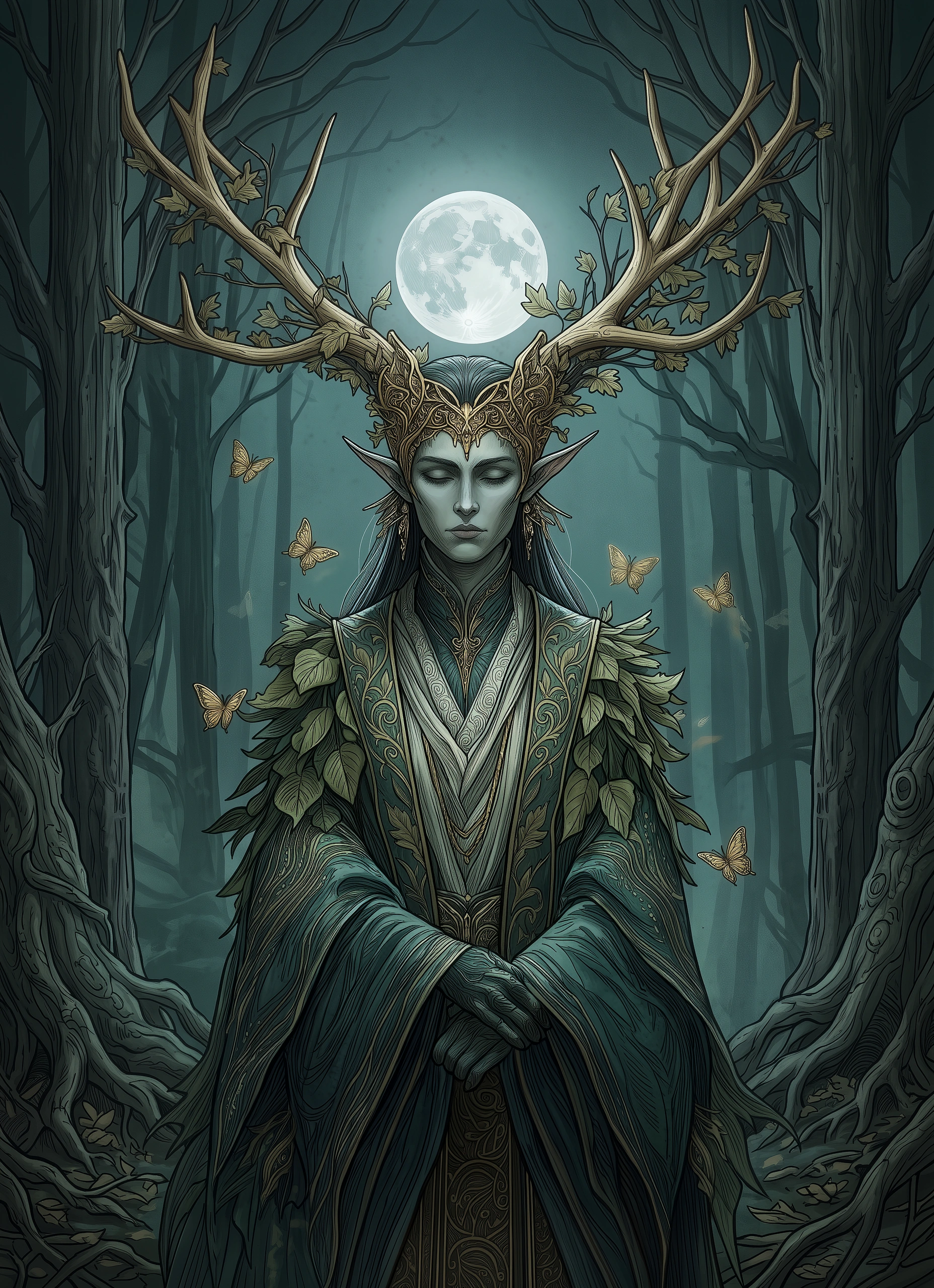
Syl Na Lira and the Elven Clans
If Lyraen's worship is a cathedral — vast, structured, and impossible to ignore — then Syl Na Lira's is a forest path. You do not attend it. You walk it, quietly, and hope you are paying sufficient attention.
On worship
The Elven Clans hold no congregations, deliver no sermons, and maintain no clergy in any recognizable sense. There are no tithes, no inquisitions, and — I confess I found this refreshing after my time in Aurelion — nobody attempted to induct me into anything. The worship of Syl Na Lira is expressed not through ritual attendance but through conduct: a quiet, insistent reverence for the natural order and an unflinching commitment to its protection from any force that would seek to corrupt or destroy it. The faithful, if they can even be called that, simply live in a manner she would find acceptable, which, speaking as someone who has spent time among the clans, sets a considerably higher bar than it might initially appear.
There are no priests in the traditional sense, no tithing, no inquisitions. The druid elders of each clan are considered the most attuned to the goddess and are revered accordingly, though I am told they would bristle at being called clergy, which I find entirely reasonable.
On All-Grove and Lyra Mor
There is, however, one place that could be considered holy in a more traditional sense. Deep in the heart of the Lyrian Woods — on ground that belongs to no single clan and is claimed by all of them equally — lies the All-Grove. At its center stands the Ageless Oak, a tree of such staggering size that the word tree feels somewhat inadequate. It serves as the only true temple of Syl Na Lira, and is considered to be her earthly residence. It is also, I should note, strictly forbidden to outsiders under any circumstances short of a direct order from the goddess herself. I inquired politely at the border of the All-Grove's territory. The response was courteous but unambiguous.
What I was permitted to know, and what the elves speak of with unmistakable mirth, is the Lyra Mor, an annual gathering of all elven clans at the All-Grove lasting two weeks. Delegates arrive from every clan without exception, a feat of respectable diplomatic consistency. It is a celebration of unity and nature in equal measure, and the one occasion during which the clans set aside whatever grievances they may carry and remember, collectively, what they share. It is here that grievances are aired, alliances are renewed, and the business of the woods is conducted beneath the canopy of the Ageless Oak.
Beyond the Lyra Mor, the elves observe the Solstice and the Moonwake as all peoples of Ardea do, though their observance carries a particular depth of sincerity I did not witness elsewhere.
The Lyra Mor also serves one other critical function: the selection of the Queen of the Wilds.
On Queen of the Wilds
The highest office associated with Syl Na Lira's worship is that of the Queen of the Wilds — her voice among mortals, her representative in the living world. The Queen is not appointed by elven politics nor born into the role. Upon the death of the reigning Queen, the selection occurs during the Lyra Mor itself, through what the elves describe as direct divine intervention — Syl Na Lira extending her favor to one among all elves present, unmistakably communicating her choice. The office is exclusive to elves, a point on which there appears to be no debate whatsoever.
The Queen acts as the voice of the goddess in the mortal world, carrying her will to the clans and serving as the highest spiritual authority in the woods. It is a role without political power in any formal sense, yet when the Queen of the Wilds speaks it is, in practice, the goddess speaking.
On character
Her disposition, by all accounts, mirrors nature itself. Those who respect her laws find her calm, gentle, and genuinely loving — a goddess who, by the elves' own telling, carved her portion of the world with deliberate care after the War in the Skies specifically so that she might nurture it and its people. A touching sentiment. One does, however, note that nature is also perfectly capable of drowning you, crushing you under a fallen oak, or introducing you to something with considerably more teeth than you were expecting. The elves are quite clear on this point: disrespect the natural order, harm what grows or breathes beneath her canopy, and Syl Na Lira's warmth becomes something considerably less comfortable.
On other gods
On the matter of Lyraen — I asked several elves, carefully and at different times, what they made of him. The responses were diplomatically phrased but remarkably consistent in their substance. Within the borders of the Lyrian Woods, they consider Syl Na Lira's authority absolute. Beyond those borders, they acknowledge Lyraen as the greater power. Their opinion of Lyraen himself is respectful of his power while being considerably less respectful of his temperament. As for his faithful — the word zealots appeared more than once, alongside fanatics and, from one particularly candid elder, people who have been told what to think since they were old enough to sit in a pew. The elves, it should be noted, appear to hold a considerably more nuanced understanding of divine history than the Path of Dawn would find comfortable.
Syl Na Lira is also not without family. She has a sister — younger, considerably livelier in temperament, and by all accounts absolutely delightful in the specific way that only genuinely unpredictable beings can be. Her name is Syl Miravel, Goddess of the Moon and undisputed queen of the Fey. Where the Elven Clans regard Syl Na Lira with love and devotion, their feelings toward Syl Miravel are something closer to fond exasperation — the sort one reserves for a beloved younger sibling who has just done something inexplicable and delightful and slightly destructive all at once. After all, among all peoples of Ardea it is the elves that are the most in touch with the Fey.
On appearance
The artistic renditions of Syl Na Lira share a remarkable consistency in their restraint. She is portrayed as an elven figure of cool, ageless serenity: pale skin carrying the faint green-grey of deep woodland shade, long dark hair, and eyes closed, as though the world visible to mortals is simply not the one she is paying attention to. Her robes are deep teal and forest green, layered and leaf-adorned, their patterns less embroidered than grown. Atop her head rises a crown of antlers wreathed in leaves and gold filigree, framing her with the quiet authority of something ancient. Golden butterflies attend her. I have been unable to determine whether this is artistic convention or eyewitness account.
Of passing interest is the full moon positioned directly behind her head — a halo of a different order than Lyraen's solar disc, and one that belongs, strictly speaking, to her sister's domain. Whether this is the artist's commentary on the bond between the two goddesses, or simply an aesthetic choice that nobody thought to question, I leave to the reader's interpretation.
Veshta, Mistress Of Shadows

Veshta and the Obscuras
I will begin this section with a professional disclosure: researching Veshta is, by a considerable margin, the least comfortable experience I have had in twenty years of academic inquiry. This includes the time I accidentally attended a Velkarath funeral, the incident with the river serpent outside Landala that I have agreed not to put in writing, and a deeply unpleasant afternoon in the Ardean College's restricted archives that my colleagues have been kind enough to pretend never happened. Attempting to document a goddess whose entire domain is secrecy is an experience I would describe as humbling at best. Several of my sources declined to be named. Several others declined to be sources at all. One simply looked at me for a long moment and walked away. What follows represents my best reconstruction of a subject that would very much prefer not to be reconstructed.
On principles
Veshta is the Goddess of Shadow and Darkness — patron of thieves, smugglers, scoundrels, and all those who conduct their business most profitably after sundown. She is the deity of the unaligned citizen of Velkarath, the cutpurse in Veridia Southern Bank who touches the small tattoo beneath his collar before a job, and everyone in between who has ever had good reason to avoid being looked at too closely. Her domain is not merely darkness as an absence of light — it is privacy, concealment, the safety of invisibility. She is, in the most theological sense possible, the goddess of minding your own business.
On worship
Her worship reflects her domain. There are no temples. There are no congregations. There are no holidays, no feast days, no rites of any kind — because any gathering of thieves and scoundrels significant enough to qualify as a religious event would also be as a gift to whatever law enforcement happened to be paying attention. The majority of her faithful only carry a small symbol — a token, a tattoo — and offer their prayers quietly, privately, often in the dark, often before whatever enterprise they are about to undertake. Gathering a room full of thieves in one place draws precisely the kind of attention that Veshta's entire theology is dedicated to avoiding.
This secrecy, it is important to understand, is not merely practical. It is the religion. Even in Velkarath, where her worship carries no legal consequence and the Night Council has no particular objection to it, her most devoted followers conduct themselves with the same discretion as they would anywhere else. The goddess does not distinguish between necessary secrecy and unnecessary secrecy. There is only secrecy, and the things that threaten it.
She has no formal clergy. She has no hierarchy. She has, however, the Obscuras.
On Obscuras
Her one formal institution is the Obscuras. They are, to the best of anyone's knowledge, an extraordinarily elite sect of chosen devotees: assassins, thieves, and operatives of such capability that they occupy a category largely separate from the rest of their respective professions. Nobody knows how they are chosen. Nobody knows their internal structure or how they communicate. They rarely accept outside contracts, preferring to pursue objectives of their own selection by criteria that remain entirely opaque. They never show their faces. Those captured take their own lives before they can be questioned. In the years I have spent researching this tome I have found exactly three firsthand accounts of encounters with Obscura operatives. Two of those accounts end with the witness expressing profound gratitude at still being alive. The third ended mid-sentence.
It is the prevailing opinion among the few scholars willing to venture a guess that Veshta is considerably more present within the Obscuras than she is with any other aspect of her following. Whether this means she selects them directly, guides them, or simply watches with something approaching satisfaction, no one can say with confidence.
On Velkarath
Within Velkarath, Veshta occupies an unusual political position. That is to say, she has none. Unlike Exanguin — whose worship bleeds directly into the Night Council's governing apparatus — Veshta has no representation there whatsoever. Her followers stay as far from official governance as possible. Of her relationship with the other Velkarath gods, little is certain. She and Exanguin are, according to sources I cannot fully verify, known to have had some form of relationship during the Divine Age. Whether any warmth survived into the current era is unknown, which is itself probably the most Veshta answer imaginable.
On character
She presents, by the accounts of those few willing to speak on the matter, two distinct faces. The first is sheltering — a cool, somewhat distant but genuine welcome extended to all who seek to avoid attention, scrutiny, or simply the business of being seen. Refugees, runaways, the persecuted and the paranoid find themselves, in their more desperate moments, reaching for Veshta as instinctively as one reaches for shadow on a hot afternoon. The second face is something else entirely. Those who seek to expose her domain — to shine light, metaphorically or literally, into places she has claimed — encounter a goddess who is cold, efficient, and entirely without sentiment on the matter. As I heard some particularly passionate people mention — there is no light bright enough for it to be impossible to snuff out.
On origins
Her role in the War in the Skies is, appropriately, obscure. What fragments exist suggest she was present for a particularly devastating engagement, after which she departed the conflict entirely and has not involved herself in anything of comparable scale since. Which side she fought for is unknown. There is a persistent suspicion that the answer to that question is both, sequentially, and that the goddess saw no particular contradiction in this. I find this entirely consistent with her character.
On appearance
Depictions of Veshta are, predictably, rare. The image reproduced here is one of perhaps a handful known to exist, and I will confess that acquiring even a copy of it involved a sequence of intermediaries, anonymous hand-offs, and one memorable note instructing me not to ask where it came from.
She is depicted as an elven woman of severe and striking aspect — tall, pale as cold stone, with extraordinarily long black hair that falls past her waist in loose strands. Her eyes are covered by a dark blindfold — which one might initially read as a symbol of blindness, before considering that a goddess whose domain is shadow has very little use for conventional sight, and considerably more use for everything else.
Her robes command the image entirely. They spread outward and downward in a vast dramatic sweep that pools across the ground and appears, at the edges, to simply dissolve — not into fabric but into the surrounding darkness itself. This is not, I believe, an artistic flourish. The robes do not appear to be made of cloth at all. They are shadow given form, shifting and patterned with intricate designs that seem to emerge from the darkness — as though the fabric is the absence of light, structured and worn.
There is no halo. There is no sun, no moon, no divine symbol radiating from behind her head. She requires none. She is already the darkest thing in the image.
Tordoron, Silent God of Mountain And Stone
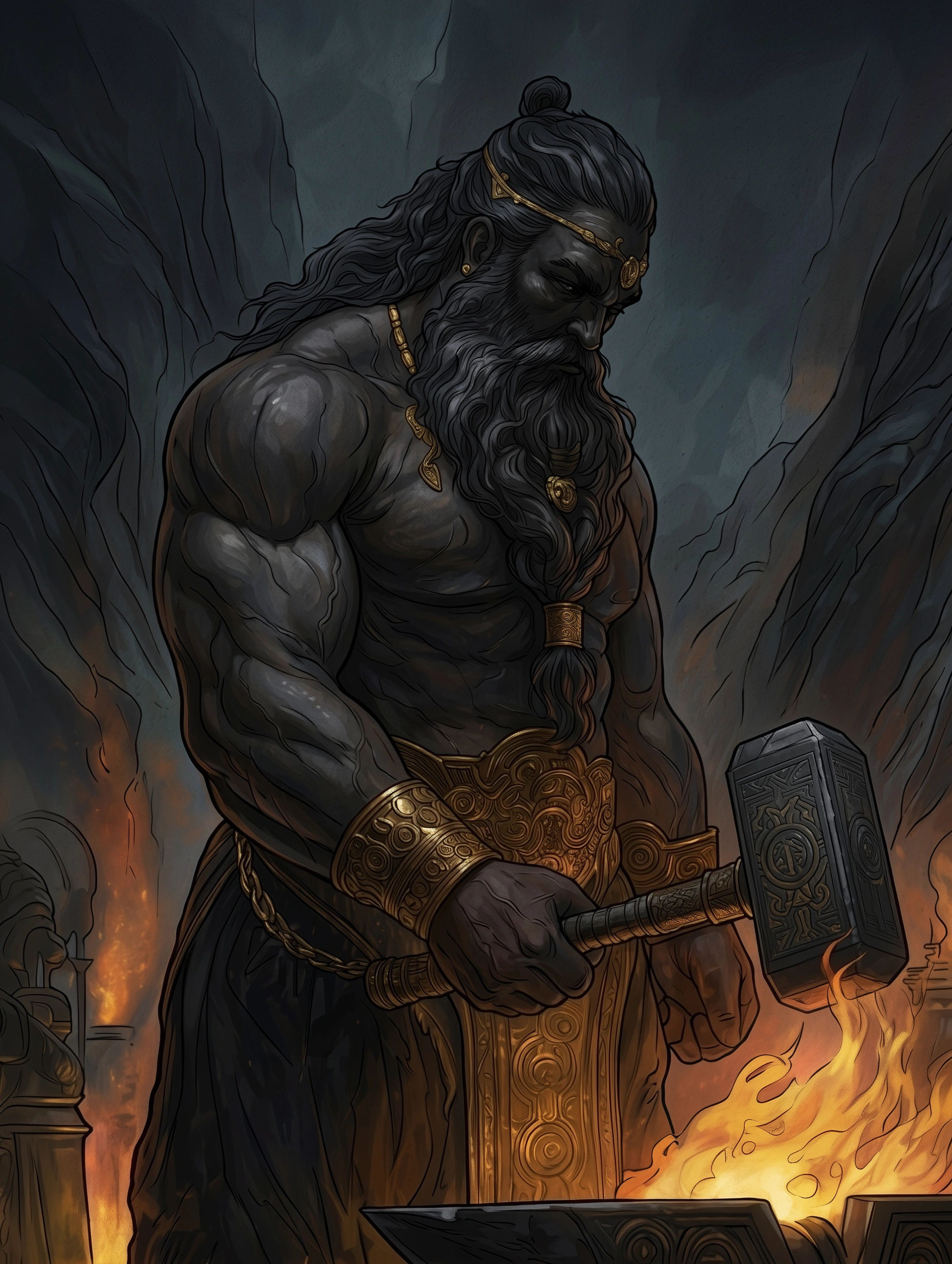
Tordoron and the Dwarven Kingdoms
There is a particular pleasure, I have found, in researching a faith that does not try to kill you, convert you, or make you feel quietly watched at all hours of the day and night. Here, at last, is a god whose faith does not demand conquest, does not traffic in shadows, and does not, to the best of my knowledge, have anyone killed for asking questions about it. The dwarves of Karak, Dor Vorum, and Zhubar are many things — blunt, industrious, occasionally baffling — but they are not, as a rule, difficult to research. They respect honest work. Academic inquiry, they have generally agreed, qualifies.
On principles
Tordoron is the Silent God — deity of mountains, stone, foundations, and craft in all its forms. He is, by the dwarves' own reckoning, among the oldest and most powerful divine forces on the continent. He is also, by their measure, the least interested in telling anyone about it. He works at his forge. He watches. He says very little. The dwarves find this deeply relatable and have organized an entire faith around it.
Its central proposition is straightforward: do your work. Do it honestly, do it with genuine effort, and you are, by the standards of the dwarves, doing perfectly fine. The laziness, the cutting of corners — that is what considered deplorable. A dwarf who swings a pickaxe with sincerity has more standing in the eyes of his god than a man of any other faith who prays elaborately and then does very little else.
Of beards, I feel I must say something, because one cannot spend significant time among dwarves without noticing the extraordinary cultural weight placed upon facial hair. A dwarf's beard is his pride, his history. The lengths to which dwarven grooming can aspire are, frankly, ridiculous. This is not mere vanity but a reflection of the god himself, who is understood to possess rather magnificent facial hair of his own.
On Craft Covenant
All honest labor is respected: farming, trade, architecture, mining, fighting. Forging and building occupy a position of particular honor, and runesmithing — an art of extraordinary complexity requiring decades of dedicated study — is treated with something approaching the reverence.
The Craft Covenant's structure is divided across three kingdoms and three senior positions. From Karak, home of the faith's oldest traditions, comes the Stone Elder, whose authority governs religious dogma and covenant law — the most purely spiritual of the three offices, with considerable religious influence. From Dor Vorum, the largest and most prominent of the dwarven kingdoms, comes the Mountain Elder, who handles its relationship to dwarven communities, its oversight of craftsmanship standards, and the practical running of temples and clergy. From Zhubar, the third kingdom, comes the Deep Elder, whose unusual domain encompasses the Deepest Paths, the stewardship of artifacts, and the maintenance of chronicle and historical record. Beneath these three, the structure is admirably simple: each temple is led by a single Elder, supported by varying numbers of lesser priests and initiates, their rank determined by experience and, one suspects, the quality of their work.
Temples themselves are large, stocky structures of dressed stone that could not be mistaken for the architecture of any other faith — they do not reach for the sky as Aurelian cathedrals do, but plant themselves into the earth as though daring it to move them. Any workplace of sufficient size will additionally maintain a shrine: a surface of smoothed stone, a pair of braziers, and a place to dedicate one's work. Which brings us to the central devotional act of the Craft Covenant. A dwarf does not sacrifice to Tordoron. A dwarf dedicates — presenting the result of considerable work to the god's attention. Tordoron recognizes the craft without taking it from the craftsman. It remains theirs. Works of extraordinary skill are revered in proportion to that skill, and there is at least one recorded instance of a Clasp of Hands forging competition victor discovering a mark upon his presented armor that he had not placed there himself. The dwarves considered this unremarkable. Of course he had been noticed.
On Clasp Of Hands and holidays
The Clasp of Hands is the Covenant's principal celebration — eight days during which dwarves gather in the great cities of the kingdoms, or travel between them, to present the fruits of their labor. It is equal parts religious festival, trade fair, crafting competition, and feast, with prizes ranging from monetary reward to professional contracts and social influence. It is, by a considerable margin, the most straightforwardly enjoyable religious event I have attended in the course of this research, and I say this as someone who spent three days eating extremely well, watching a runesmithing competition I did not understand at all, and being treated with the particular begrudging warmth dwarves extend to anyone they have decided is sufficiently serious about their work.
The lesser observances of the Craft Covenant are, admittedly, fewer. The Long Silence is a single day during which speech is kept to the barest minimum — work continues entirely as normal, because of course it does, but the silence itself is the direct reflection of the god's own nature. There is something clarifying about an entire city going about its business in almost complete quiet. Elder's Rest is its philosophical counterpart — one day set aside not for silence but for stillness of a different kind: reflection upon work completed rather than continuation of it. The idea here is practical rather than sentimental. The dwarves hold that labor pursued without rest degrades in quality, and Tordoron, as the ultimate craftsman, would not tolerate degraded work. Binding Day, finally, marks the formal completion of an apprenticeship across any trade, celebrated whenever it falls rather than on a fixed date. A personal holiday by nature, observed with modest ceremony and, naturally, a beard-related comment from the newly qualified craftsman's master.
On Deepest Paths
The Deepest Paths are, by any reasonable assessment, Tordoron's most staggering achievement — an underground road network of continental scale, constructed during the Divine Age, connecting the whole of Ardea beneath the surface. The skeptic in me reaches for the word legend. The scholar in me notes that every piece of evidence examined, in the kingdoms and beyond, suggests the Paths are at the very minimum vast, and quite possibly exactly as described. Beneath the dwarven kingdoms themselves, significant sections have been cleared, rebuilt, and restored to active use — the monsters that overran them in the aftermath of the War in the Skies driven back, the cave-ins excavated, the passages made navigable once more. Beyond those borders, the Paths are unmapped and extraordinarily dangerous. Non-dwarves are permitted entry into the accessible sections, provided they are accompanied by a dwarven guide — with the exception of certain passages reserved for burials and specific shrines, which remain exclusively dwarven.
On Divine Forge
Dwarven legend holds that Tordoron's forge is real — a physical location hidden somewhere beneath the earth, lost to the kingdoms but accessible, in principle, somewhere along the Deepest Paths. Several accounts exist of dwarves who became lost in the unmapped sections of the Paths and later emerged claiming to have glimpsed something in the deep dark that they could not satisfactorily describe, but consistently associated with heat, light, and the sound of hammering. The Deep Elder's chronicle notes these accounts as is, which I find more interesting than any amount of argument.
On character
Tordoron himself is, as his title suggests, silent and largely removed from direct mortal engagement. He does not communicate through clergy, does not issue commandments, does not appear in visions or demand specific devotions. The dwarves do not experience this as absence. They describe him as the most venerated elder — not an object of blind devotion but of immense, earned respect, a silent and friendly presence looking over the shoulder of every craftsman who approaches their work with genuine intent. And not, they would emphasize, without evidence. His blessings are real but subtle — a fortunate strike of the pickaxe, an unexpected elegance in a piece that exceeded the craftsman's intention, a mark appearing on a finished work that no hand placed. He is present in the way that mastery is present in any craft: invisibly, undeniably, recognizable to those who know what to look for.
On origins
On the matter of Tordoron's origins and his place in the War in the Skies — the dwarven accounts are, characteristically, less concerned with drama than with fact. He was among Lyraen's earliest and most crucial allies in that conflict, by all accounts. Some dwarven texts suggest that his true might surpasses even that of the Sun God — a claim Tordoron himself has never made, and which his stoic remove makes impossible to confirm. There are references in reliable texts to a brotherhood between him and Lyraen, though the stoic nature of the Silent God means it is not a bond he tends actively. Whether Lyraen values it regardless, I cannot say. I note that the Path of Dawn acknowledges Tordoron with considerable respect, which for an institution not known for generosity toward other faiths is perhaps evidence enough.
On appearance
The depiction of Tordoron available to this scholar is, like the god himself, entirely unconcerned with your opinion of it. Where Lyraen spreads his wings for the viewer and Syl Na Lira stands in serene composure, Tordoron does not look up. He is working. He was working before you arrived, he will be working after you leave.
His skin is the deep charcoal of dark stone, the color of the mountain's interior rather than its face, as though he were not a being who inhabits the earth so much as one who is it. His hair is dark and long, swept partially into a topknot — practical rather than decorative, the arrangement of someone who simply needed it out of the way.
And then there is the beard. I feel the earlier cultural observation about dwarven facial pride now requires no further explanation. Tordoron's beard is a magnificent braided construction of considerable length and evident care.
The hammer itself deserves mention — dark-headed, rune-carved, its markings the same script found throughout the Deepest Paths by those few scholars able to examine them. The forge behind him breathes with heat. He does not look up. Whatever he is making, it has his full attention.
One final detail, drawn from sources the dwarves themselves classify as unreliable. Before the War in the Skies, Tordoron is said to have had a wife: a goddess known only as the Hearthkeeper, whose name and fate are unrecorded. The dwarves who think about it at all do so quietly and without elaboration. What became of her, and whether her absence has anything to do with Tordoron's profound and lasting silence, is not known. Some silences, I have learned, are there for a reason.
Which, all things considered, feels appropriate.
Exanguin, Lord Of Blood
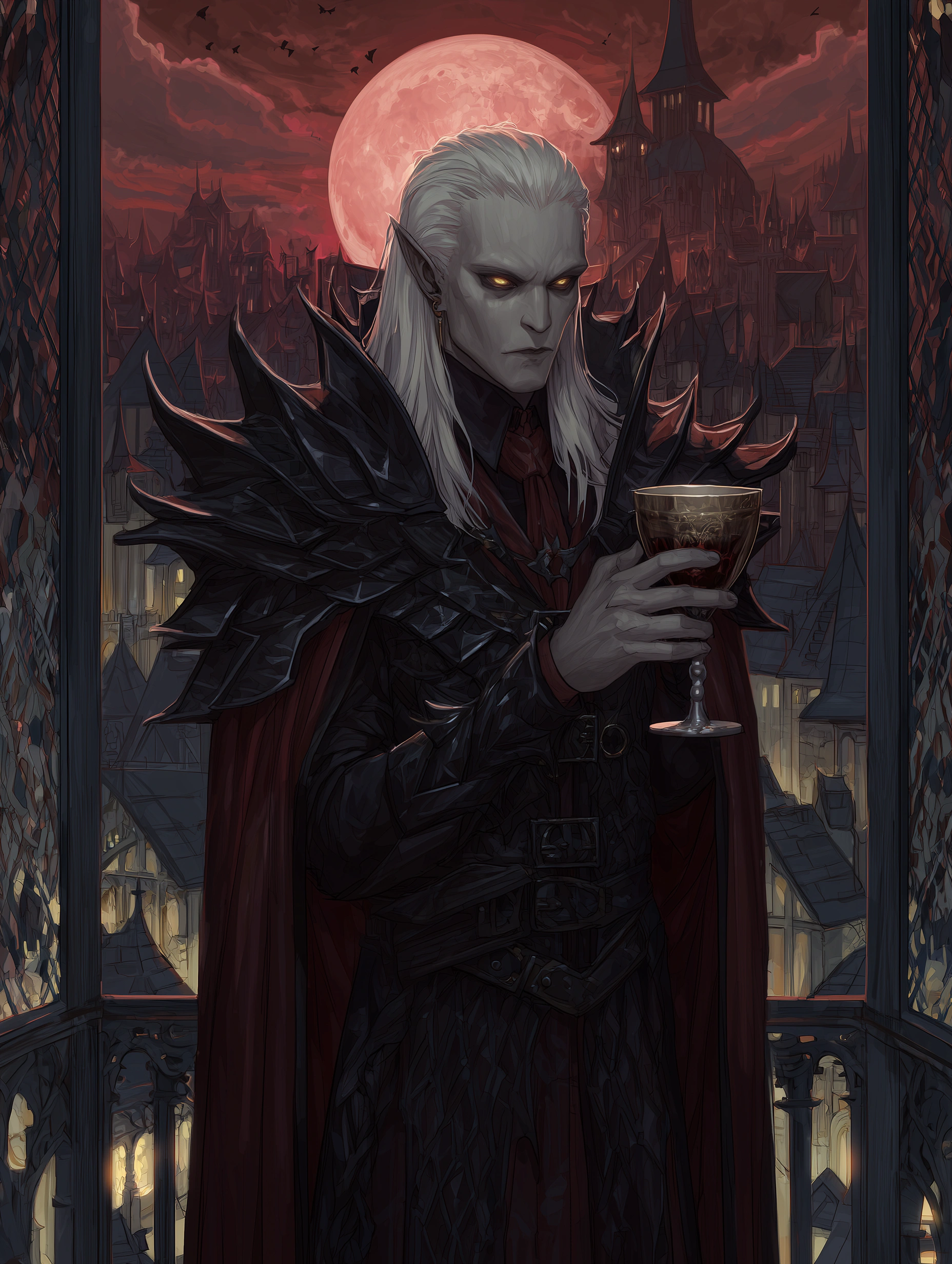
Exanguin and the Vampire Counts
I have, in the course of researching this volume, attended a dwarven silence day, been politely refused entry to an elven sacred grove, spent an uncomfortable afternoon feeling watched by a goddess of shadows, and navigated the bureaucratic machinery of the Path of Dawn's hierarchy. And now I can say that I have sat at a table with a Crimson Priest and conducted an interview. I would like the reader to know that I did it in the name of scholarship and that I left the encounter with all of my blood still in my body, which I am choosing to regard as a professional success.
On principles
Lyraen's church is overbearing but earnest. Veshta is dangerous but comprehensible. Exanguin is different. Exanguin is, by any reasonable moral framework applied by any civilization on the continent of Ardea, simply and unambiguously evil. I note this as the closest thing to an objective statement this volume contains.
Exanguin is the God of Blood, War, and Power. He is the lord of the Vampire Counts of Velkarath, the patron of every enterprise involving subjugation, bloodshed, and the exercise of absolute dominion over others. His domain is blood in its most literal sense, and power in its most brutal — though he has, over the long centuries of his existence, developed something considerably more nuanced than simple carnage, which makes him, if anything, more unsettling.
On Vampire Counts
To understand Exanguin is to first understand the Vampire Counts, for the two are effectively inseparable. The Counts are not, despite what one might assume, barbaric. Underestimating them on those grounds has historically carried severe consequences for the people who did so. The Vampire Counts maintain a rigidly structured noble feudal hierarchy — houses at the apex, lesser spawn at the base — with all the grand ceremony, political intrigue, and ostentatious refinement that implies. Grand balls. Elaborate social theater. Refined taste in art, music, clothing and architecture. A vampire count who engineers a rival's political humiliation through three years of careful social maneuvering considers this equally worthy of their lord's favor as tearing someone apart with their hands. Exanguin, by all accounts, agrees. Elegance of method is appreciated. Results are what matter.
The Counts treat Exanguin as an absolute sovereign whose word allows no disobedience, at a cost they are extremely clear about. He is the ultimate lord. Beneath him the Counts maintain their houses, their politics, their hierarchies. They are, in short, an aristocracy that happens to drink blood, worship a deity of immense horror, and occasionally attend each other's funerals under circumstances they themselves arranged. I find them professionally fascinating and personally alarming.
The Vampire Counts observe several celebrations depending on their house, but the one event that unites them all is the Masquerade — a ball of genuinely staggering proportions, ostentatious and perverse in equal measure, during which rivers of blood are consumed and shed simultaneously. Alliances are forged. Enemies are undermined. Ancient grudges find new expression. And quite often someone does not make it to the end of the evening, which is understood by all attendees as an occupational hazard and, in its own way, an offering. Exanguin himself attends. This is not metaphor. He is present at the Masquerade as both observer and active participant — watching, moving among his flock, instigating where it suits him. And the presence of several of the Crimson Priests are also a given.
On Crimson Priests
The Crimson Priests are Exanguin's traveling clergy — there is no cathedral, no permanent base of operations, no fixed hierarchy in the traditional sense. They move through the land to sites of ritual significance, massacre, and bloodshed, conducting ceremonies and spreading their faith with what I can only describe as infectious enthusiasm. They are more than willing to discuss their lord at length, with a conversational openness that I found both useful and deeply alarming. The Vampire Counts treat them as near-kin — the only non-vampiric worshipers worthy of genuine recognition and respect rather than being considered blood bags. This distinction is earned. The Priests are erudite, charismatic and extraordinarily dangerous, and they wear all three qualities simultaneously with the comfort of old clothes. I conducted my interview in a public location, in daylight, and with two colleagues waiting outside who were under instruction to leave immediately and without looking back if I had not emerged within the hour. The Priest seemed slightly disappointed by the fact I only had a single hour to talk.
Their rituals center on blood in both its quantitative and qualitative dimensions. Blood offered to Exanguin is assessed on two properties: volume and rarity. Greater quantities incur greater favor; insufficient quantities are considered a genuine affront, with consequences the Priest described with unsettling specificity. As for quality — the rarer the blood, the greater its worth. The Priest I spoke with offered a following comparison: a single drop of dragon blood, offered correctly, outweighs the full blood content of a thousand human bodies. The Priest offered this information in the tone of someone sharing an interesting wine recommendation.
On Velkarath
On Velkarath's Night Council Exanguin maintains representation through a rotating vampire count — a single seat held until replaced by politics or assassination, which in vampiric terms are broadly synonymous.
His relationships with the other gods of Velkarath are best described as professional distance. Veshta and he maintain their respective domains without meaningful conflict, the possible nature of their relationship was expanded upon earlier. Ossivar is, by Exanguin's evident estimation, not worth forming an opinion about — which places him in the unusual position of agreeing with Lyraen on at least one subject, though I would strongly advise against mentioning this to either of them.
On character
The god himself mirrors his congregation — or rather, the congregation mirrors him, which is the more accurate direction of causality. He presents, in his direct manifestations and in the descriptions offered by those who have encountered him as a refined, eloquent, impeccably mannered noble of evident intelligence and considerable charm. Polite beyond reproach. Highly educated. The sort of presence that commands a room through quality rather than volume. Genuinely cultured. And absolutely, unremittingly terrifying — not despite these qualities but through them, because the thin smile that never quite leaves his face communicates that everything pleasant he presents is a surface beneath which something vast and monstrous is watching. His other aspect is the direct inverse of this presentation: a being of pure, exultant violence, bathing in blood, grinning through carnage, tearing through the world with the same uncanny smile now worn openly. Both are entirely genuine. Both are entirely him. The mask is not false. The monster is not hidden. They are simply two fluent languages, and he moves between them at will.
There is, however, a third facet — quieter, stranger, and almost entirely unknown outside the most dedicated archival research. Ancient texts, fragmentary and disputed, describe a dimension of Exanguin connected not to violence or dominion but to memory — specifically, the memory carried in blood itself. The collective knowledge that passes from ancestor to descendant through lineage, stored in the veins, transmitted forward through generations. This aspect is described as serene, curious, almost archival in its disposition. I find it the most genuinely fascinating element of a deeply unpleasant subject, and I note, upon reflection, that it may explain more about the aristocratic refinement of his primary face than anything else. The cruelty and the curiosity are, it seems, aspects of the same obsession.
He is, by a significant margin, the most directly present of Ardea's active deities in the mortal world — appearing at Masquerades, visiting prominent Houses, occasionally manifesting to show favor at particularly impressive rituals. There is a well-documented account of a battle between two large warring tribes during which witnesses reported the moon turning red, and upon the battle's conclusion the surviving few looked up to see Exanguin's likeness in the sky above them, looking down at the carnage with what is described as a condescending smile. Satisfied. Entertained.
On origins
Of his origins — this is the detail that separates Exanguin from every other deity in this volume, and which I find most remarkable. He was not born a god. He was a man. An extraordinary man, by all accounts — of staggering personal power, fighting on the side of the Betrayer during the War in the Skies — who ascended to genuine divinity through the consumption of divine blood spilled during the conflict, until all mortality has burned away within him. The Vampire Counts state this openly and with considerable pride, as it makes their god's claim to power not inherited but earned, which is a distinction that matters to them enormously. He survived the war's conclusion by means unknown. And there is evidence, in several sources that the vampires themselves are his creation — an augmentation of his forces during the war that outlasted the conflict and became something rather larger than intended. Whether Exanguin considers this an achievement or a complication is not recorded.
On appearance
He presents as an elven figure of severe elegance — ashen skin, the grey-white of something from which warmth has long since departed, framed by long silver hair that falls straight and sleek past his shoulders. His armor is black and aggressively structured, its shoulders erupting in blade-like protrusions that read simultaneously as decorative and lethal — the aesthetic of someone who has made the deliberate choice to dress like a weapon while attending a social function. A deep crimson cape falls behind him, the color of what is in the goblet, which he holds with the consideration of a man evaluating a vintage.
The eyes are where I find myself returning, and returning, and returning again with decreasing comfort each time. They glow — amber and gold, bright enough against the ashen skin to read immediately as inhuman — and they are remarkable. Striking. The kind of eyes that in a different context, on a different face, might be called beautiful. The problem is everything around them. They are the eyes of something that is examining you with complete thoroughness and has already, before you have finished saying your name, determined the exact way in which to dismember you. The refinement is entirely genuine. The monster beneath it is also entirely genuine. The unsettling achievement of this image is that both of these things are equally visible and that neither diminishes the other in the slightest.
Syl Miravel, The Moon

Syl Miravel and the Fey
[The author notes that the following has been amended six times across three drafts, following consultation with two elven scholars, one Fey entity that insisted on being called something different each time it was addressed, and a separate incident involving a toadstool that I have agreed not to document. The current content is a compromise. I am told it is wrong. I am told that everything is wrong and also fine.]
I have, in the course of this volume, written about a god who demands blood sacrifice, a goddess whose followers spy on humble researchers, and a deity whose divine forge is lost somewhere beneath an unmapped and monster-infested underground network. None of these prepared me for Syl Miravel.
On principles
Writing about Syl Miravel presents a methodological problem that I will state plainly: every source contradicts every other source, and all of them are correct. This is not a reflection of inadequate research. It is, I am now convinced, the only accurate thing one can say about her. I spoke with several sources during the preparation of this section — four elven scholars, three Fey entities willing to be interviewed, two druids of the elven clans, one extremely opinionated river, and a traveling merchant from the eastern roads who had an encounter he couldn't explain and hasn't stopped thinking about since. Their accounts agreed on the following: she exists, she is associated with the moon, and she is not to be trifled with. Everything beyond this was contradictory, impossible, and somehow all of it felt true.
On Fey
The Fey who serve her operate under rules of extraordinary specificity and absurdity. Names, for instance, carry terrible weight in their dealings — names given freely become property, names spoken carelessly become handles, and their own names shift depending on who is asking, in what language, at what hour, whether there is iron nearby, and the current phase of the moon. Bargains made with the Fey are binding in ways that defy mortal contract law and several laws of physics. One must not thank them. One must not lie to them but need not tell the whole truth. One must not eat what they offer, or drink it, or smell it for too long, or look at it during a full moon. The Fey do not lie — this much is agreed upon universally — but they speak in a manner that treats truth as a horizon rather than a destination, visible but never arrived at.
Their rituals, such as I could document them, resist uniformity. The methods by which one seeks audience with Syl Miravel was described to me as follows by three separate sources: enter a faerie ring at midnight and walk its circumference nine times counterclockwise; leave an offering of salt and silver at a crossroads on the night of the full moon and do not look back; wait by still water until something looks back from underneath. Whether any or all of them work - haven’t the faintest.
I attempted to attend a Fey gathering. I found my notes afterward arranged in an order I had not left them in, spelling something in a language I do not speak but which my research assistant translated, with great trouble, as approximately: you are welcome to observe but your trousers are very funny.
Beyond that, I will offer only what my most reliable elven source told me when I asked her for one piece of advice about approaching the Fey. She thought about it for a long moment.
Be charming, she said. Be interesting. And whatever you do, do not be boring. Boring is the one thing they will not forgive.
On Stealing of the Moon
The myth of the Stealing of the Moon — the reason Syl Miravel's moon vanishes entirely from the sky for the duration of Aet Sol each year — is perhaps the richest example of this interpretive chaos. I collected seven accounts. In three of them something was taken from her. In two of them she gave something willingly. In one account the moon was never stolen at all, and I was told I simply misunderstood what the moon was. In the seventh, which came from a Fey source who spent the interview sitting in a tree and addressing me exclusively as scribble monkey, the answer was a question: does it matter why, if it always comes back?
On character
What the research does establish, across even the most contradictory sources, is this: Syl Miravel is not malevolent. Mischievous — profoundly, inexhaustibly, and with a creativity that suggests genuine enjoyment rather than malice. The distinction matters, though it offers no practical comfort to those on the receiving end of her attention. She is curious about mortals in the way that a very intelligent creature is curious about something it finds unexpectedly interesting: attentively and with a capacity for intervention that operates entirely on her own terms and timeline.
On appearance
I have spent longer than is advisable looking at this image and I am still not entirely sure I have seen all of it. Every time I look away and look back there is something different in the periphery — a different leaf, a different shadow, a small figure near her hair that I cannot determine is painted or is simply there. It’s becoming unhealthy for me.
She is joyful. Genuinely, openly, privately joyful in the manner of someone in the middle of a joke that only they know the punchline to. The goddess of the Fey is simply, thoroughly, delighted about something, and whatever it is, you will not be told.
Her form is elven, pale-skinned, and almost entirely inseparable from the vegetation surrounding her. Where her sister stands apart from the forest in composed distinction, this figure merges with it — leaves, petals, vines and flowers erupt from her hair and clothing in a riot of color so overwhelming that color barely covers it: deep purples bleeding into magenta, orange into gold into green, the palette of a forest that has decided restraint is for other forests. It is the loudest image in this volume by a considerable margin and I suspect this is intentional.
Ossivar, The Gravekeeper

Ossivar and the Mortis Accord
I will open with a disclosure: the primary source for this section is a single interview with a member of a sect I will describe in due course, conducted on one long evening over tea. They were, I will say without hesitation, the one of the most pleasant research subjects in this entire volume. What follows is the outcome.
On principles
The first and foremost thing to understand about Ossivar is what he is not. He is not the god of violence, war, bloodshed or brutality. He did not cause death and does not seek it. He is the Gravekeeper — the patient administrator of the longest queue in existence. His domain is the afterlife: the routing, filtering, cataloguing, and housing of every mortal soul that has ever drawn its last breath on Ardean soil. The dead arrive. He receives them. This has been his work since before anyone now living can trace, and he has not once called in sick.
The disruption of this process — the forcible return of souls to the living world through necromantic practice — is the single thing that disturbs him. It is not merely that necromancy offends him aesthetically, though one suspects it does. It is that practitioners of the craft are using the energy of his domain to work directly against what that domain exists to accomplish: to let the dead rest. They have taken something belonging to a very specific, very ancient, very patient process and turned it into a weapon against that process itself. Ossivar finds this objectionable. He finds it objectionable with the quiet dignity of someone too old and too composed to raise his voice about it.
On character
He is ancient beyond meaningful measurement, and patient in a way that makes Tordoron look impulsive. He carries what my source described as a considerate idleness, a phrase so precisely accurate that I have borrowed it. He has no reason to hurry. Mortals will die when they die. The dead will arrive when they arrive. The work will be there, as it has always been there, and he will attend to it as he has always attended to it. He has, by all accounts, a passive and genuine curiosity about mortals — their experiences, their stories, the particular shapes their brief lives take — but it is the curiosity of an archivist rather than a confidant.
His contempt for those who abuse his domain is real but profoundly muted — the quiet, exasperated disdain of someone watching a child ignore instructions and blunder forward arrogantly. It is not anger. It is something older and more tired than anger — disappointment. He does not act on it. He does not intervene. He simply continues his work, with the certainty of something that knows it will be the last thing standing — because they always end up in his domain regardless. He is never in a hurry because he always wins.
On World Ossuary
The World Ossuary is Ossivar's domain and sole residence — the afterlife itself, of which he is keeper and single warden. It is not a physical location. The Ossuary exists in a different sense than mountains or cities exist, and attempting to walk to it is an error of category rather than of navigation.
What is known of its internal structure comes almost entirely from the Morticians, whose access to certain glimpses of the Ossuary is suspected but unverified. According to their accounts, the Ossuary is sectioned — organized with care, according to the beliefs, cultures, faiths, and circumstances of the souls it receives. A soul arrives carrying the weight of its convictions and its life, and is routed accordingly. The filtering process is extraordinarily sophisticated — the product of a system capable to account for every faith on the continent, every culture, every individual case that a mortal life can produce. It does not turn souls away on any grounds. It houses them all, invariably.
I asked my source whether this means the faithful of every religion end up in the same place regardless of what their clergy tell them. They smiled and said that housing them all did not mean housing them identically, and that the sectioning was considerably more nuanced than that. They declined to elaborate.
On Mortis Accord
The Mortis Accord is the faction most commonly associated with Ossivar by the wider world, which is an irony so complete that I find it almost elegant.
The Accord consists of two allied factions. The Necromancers are the practitioners of the art of raising the dead. They are the primary source of Ossivar's quiet grievances, being directly and repeatedly responsible for the disruption of his domain. Then there are the Death Knights — smaller in number by several orders of magnitude, but individually of a power that dwarfs the average necromancer considerably. How one becomes a Death Knight is unknown. What is known is that something called The Oath defines them — powers them, becomes them, or something else entirely that does not map cleanly onto either of those descriptions.
The Accord does not worship Ossivar. I want to be precise about this, as it is frequently misunderstood. They are aware of him and have reached the collective conclusion that a god so thoroughly removed from the world constitutes no meaningful authority over it. They consider themselves the true architects of the life-death balance, or at minimum its rightful custodians. They know they offend their god. They have decided this is his problem.
This is either the boldest theological position I have encountered in twenty years of research or the most catastrophically mistaken one. I have a strong suspicion it is both, and that the eventual resolution will be highly educational.
On Morticians
In the quieter corners of Ardea there exists a sect that most readers will not have heard of, and which I am somewhat cautious about publicizing even here: the Morticians.
The Morticians are, in the strictest sense, the only people on the continent who worship Ossivar as he intended, in accordance with his domain's actual purpose. They are few in number, rigorously private, and united by a sincere and active opposition to necromancy and the disruption of the natural order of death. Where the Accord treats the afterlife as raw material, the Morticians treat it as something sacred. They exist to make right what necromancy has made wrong — to restore, as best they can, the order that necromantic practice subverts.
In older centuries, during periods of greater institutional tolerance, certain Morticians lent their knowledge to forces of light working against the Accord. I am including this historical note and moving past it at some speed. As I said before, I would prefer to continue being published.
Whether Ossivar communicates with the Morticians directly is a matter of genuine uncertainty. Some evidence suggests he grants them occasional glimpses into the World Ossuary — knowledge that could not be acquired through any other available means. My source was thoughtful on this point for a very long time before saying that glimpses was not quite the right word, and that it implied a relationship more direct than they were comfortable claiming. I found this the most interesting non-answer I received across the entire course of my research.
On origins
Ossivar's origins are unknown even to his most devoted followers. The most consistent account across various fragmentary sources is that he was tasked with the stewardship of the afterlife by entities described only as Life and Death. Whether these are gods of some older and forgotten order, forces of a nature that predates the divine, or something else entirely, is impossible to determine. When I put this question to my Mortician source, they became very still, and said they preferred not to speculate on the nature of things older than things themselves.
Ossivar simply is. He was here before the War in the Skies. He will be here after everything else. He is waiting, with a patience that makes the concept of patience feel mildly insufficient, for all of us to arrive.
I find this oddly comforting. Your experience may differ.
On appearance
Like I implied in previous sections, every other depiction in this volume makes a statement. Lyraen blazes. Veshta looms. Exanguin surveys his city with a goblet and a half-smile. Tordoron works. Even Syl Miravel manages to catch the gaze. But Ossivar simply sits.
He is skeletal — not a representation of death but death itself given patient form, a skull emerging from a deep hood into the dim green light of what appears to be a vast and ancient hall. His robes are dark, simply cut, patterned at the shoulder with geometric markings that speak of age rather than ornament — the garment of someone who dressed for function long ago and has seen no reason to revisit the decision. His hands rest on his knees, bare bone, calm. His feet, also bare, rest on the step below. Around him in the background, barely visible, shapes drift at the edges of the light. One prefers not to speculate too specifically about what they are.
He is, of all the divine figures in this volume, the one who looks most like he simply lives here. Because he does.
And in the end, so will everyone else.