
Elven Clans
Contents
Introduction
Song Of Ages, People and Roots, by the Brightsong Clan
When the sky took fire and the world came apart
She opened the wood and she gathered us in
We entered as strangers, with sorrow in heart
And stayed until shelter had made us her kin
We were the eldest and the most numerous of the people who walked the world before the sky broke. When the War in the Skies unmade all things, Syl Na Lira — Mother of Roots and Rivers — drew us into the wood she was carving for herself and closed the green around us. We were spared. And being spared, we became hers.
Yet we were never one folk in the way the others reckon. We are many: eight clans bound by a mother and a single land, each walking a different reading of the same green truth — and once we were nine. This is the chronicle of how one sheltered people came to be sundered into clans without ever ceasing to be one — of the Farseers who first heard the goddess and the truths they carried away from her, and of the silence kept at the heart of the wood, which we do not break even now.
Breaking
Three roads ran out, far from the flame
One to the wood, where the leaf grew wide
One to the wild, that lost its own name
One to the dark, on the ruin's side
We are the eldest of the kindreds, and we were the many. Before the sky was broken we walked a world still whole, in the long green morning of things, when the gods were neighbours and the wood had not yet learned grief. We lived close to the deep order of the world and it lived close to us; our days were long, our sorrows few, and what we knew of root and river and the turning of the seasons, no people has known so well since.
Then the high ones turned upon one another. What the sun-folk and the stone-folk name the War in the Skies, we remember as the Breaking. The gods unmade each other, and unmade the world in the doing of it — the seas stood up, the mountains were thrown down, and the green we had always trusted began to burn. There is no song that holds the whole of that ruin. There couldn’t be.
Of all the gods, it was Syl Na Lira, Mother of Roots and Rivers, who turned from the war to look at what the war was killing. She would not see her people unmade for a quarrel that was never theirs. So she carved away a portion of the failing world and grew it into a wood, and into that wood she called us. And when the last of us she could reach had crossed beneath the leaves, she closed the green behind them. The Breaking raged on without. Within, there was shadow, and quiet. We were saved. And in the saving we ceased to be merely people and became, in truth, hers.
That wood is our home and our sanctuary still. In the common speech it is the Lyrian Woods; in the elder tongue, Sylth'raen Vael — the Veil of First Roots — for it was the first new-grown thing of the world after the Breaking. At its heart stands the Oak. The ground beneath it belongs to every clan and to none; we name it the All-Grove, and under the Ageless Oak we still gather, once in the turning of each year to remember that whatever else we have become, we came in together under the same leaves.
But not all of us were gathered in. Two sorts were lost to us in the saving, and we speak of them differently, for they were lost in different ways.
The first were lost by no fault of their own. The green closed only so far and only so fast, and there were those it could not reach in time, scattered on the roads of the dying world, left to wander what remained outside. These are the wayward kin, and they are out there yet: elves who never knew the wood, whose children's children have forgotten they were ever meant to come home. We grieve them. The second we do not grieve, for they were not lost — they turned. When she called, some among us would not come. They had taken the other side in the Breaking, the side of the dark and the unmaking, and they loved what they had chosen more than they loved her. So they stayed without, in the burning, and the burning entered them, and the green went out of them entirely. What walked away from that choice was no longer as we are. The world calls them the drow now. We do not call them kin.
Nine bowed their heads to hear the Mother's word
And each received it truly, yet apart
No single mind could hold the whole they heard
So each took home the part that fit the heart
In the long quiet that followed the closing of the wood, we set ourselves to learn the green — for she does not teach in words, and the whole of her truth is past any one mind to hold. Yet there were nine among us who came nearer to it than any other, nine who listened until they heard her clearest. We name them the Aelvyr, Farseers. Each heard a different note of the same great silence; each carried away a single facet of a truth too vast to carry whole. And the rest of us, in time, drifted — not driven, not divided, only drawn, each to the Farseer whose hearing rang truest in our own hearts. That is how we came to be sundered into clans without ever once being torn apart. Nine they were. Eight we still name.

Verdant Heart
Be still, and the green will speak its mind
Be patient, and the slow root splits the stone
Who runs the wood leaves half of it behind
Who stays to listen never walks alone
Thus we sing of Ornigal the Listener and his people.
Aelvyr
Of the nine, Ornigal is the one most songs name eldest. He was the still one, the Listener. Where the others went out across the wood to seek their own green, Ornigal went down. He did not believe the Mother's truth was a thing to be chased; he believed it was a thing to be heard, and that hearing asks only that one grow quiet enough, and stay still long enough. So he sat in the shadow of the Ageless Oak, and listened, and what he heard he kept.
They say he reached deeper than any of the nine — all but one. There was another who reached further still, and the two of them were closer than two branches of a single trunk. Of that other we do not speak. Ornigal turned downward and was saved; the other went on and was lost. It is said he understood that road better than any elf living, because he had felt, for one moment, the pull of it in himself. When the wood fell silent on the matter, his was the first silence and the deepest, and he held it to the end of his days. He was the Farseer who truly heard the forest.
Principles
The Verdant Heart keep the oldest and plainest of the readings: that the green is enough. Where the other clans each took a single thread of the Mother's truth and followed it outward — to the river, the beast, the song, the flame — the Verdant Heart took the green itself, whole and unadorned, and asked nothing more of it than to be near it. Theirs is not a faith of deeds but of presence. One does not honor the Mother, as they understand her, by building or burning or singing. One honors her by growing rightly, as a tree grows rightly, asking only sun and rain and time.
They are the most rooted of us, in every sense of the word. They reach for nothing beyond the leaf-line, and the long memory of the wood has not yet proven them wrong. To the wise of Verdant Heart everything worth the knowing is already here beneath the canopy, waiting for any patient enough to listen. From this comes their quiet weight among us. They command nothing and ask for nothing; yet when the Verdant Heart speak beneath the Oak, the whole wood leans in, for theirs is held to be the truest hearing of the Mother that is left to us.

People
They dwell in the deep heart of Sylth'raen Vael, in the eldest groves, nearer the Ageless Oak than any other clan is suffered to keep — for it has long been agreed that if any are to live in the shadow of the Mother's own tree, it should be those least likely to trouble it. More druids walk among the Verdant Heart than among all the rest of us together, and their elders are reckoned the most attuned to her of any living elf.
They are an unhurried people. They speak little and decide slowly, weighing a matter not in days but in seasons, and they are easily mistaken for cold until one has sat inside their silence long enough to feel how full of attention it is. They seldom leave the wood; the world beyond holds little they want and much they mistrust. But when the clans gather and a matter of the faith must be settled plainly, it is to the Verdant Heart that the wood turns, and their quiet word carries farther than louder ones. They keep the oldest customs, tend the most sacred ground and wait for the rest of us to come home.

Silver River
The river keeps no border but its own
It leaves the leaf and meets the stranger shore
And trades its silver for the world unknown
Then bears that knowing home, and asks for more
Thus we sing of Maris Iridian and his people.
Aelvyr
Maris Iridian was the youngest and the warmest of the nine. He was curious — openly, restlessly curious — about the peoples beyond the wood: the stone-folk and the sun-folk and all the kindreds the Mother had not gathered under her leaf. To a people newly saved and grateful for their shelter, this was a faintly improper hunger, and the circle never quite knew what to make of it.
Where his brothers and sisters heard the Mother in the green that stays — in root and bough and the patient turning of the seasons — Maris heard her in the one green thing that leaves. He listened to the river: the water that slips the wall, runs out past the leaf-line into the wide and dangerous world, and then, having met everything, turns and comes home. In that he found his whole teaching. He looked at the boundary of the shelter, where every other saw a wall to be kept, and saw instead a ford to be crossed. He was the Farseer who greeted with open arms.
Principles
The Mother is of rivers as much as of roots, they hold, and a river keeps faith not by staying but by going — by crossing out and meeting whatever it finds. To guard the wood is one way to love it. To go out and speak well of it is another.
At the heart of their way is the confluence, the place where two waters meet. When stream joins stream they become one larger water, and neither is the poorer for it. So the Silver River look on the stranger not as a danger to be walled out but as a current to be met, trusting that the meeting widens the wood rather than thinning it. They keep their word as other clans keep their borders and they hold, as a plain truth of water, that a stream which never runs goes foul. A wood that only ever guards itself is already half-drowned in its own stillness.
They are not fools, for all their warmth. The river carries both ways, and no one knows better than they that an open door is the one place harm can enter. So their openness is shrewd, not blind: a welcome with clear eyes. They are the door of the wood, and they have never forgotten that to be the door is also to be the watch upon it.
People
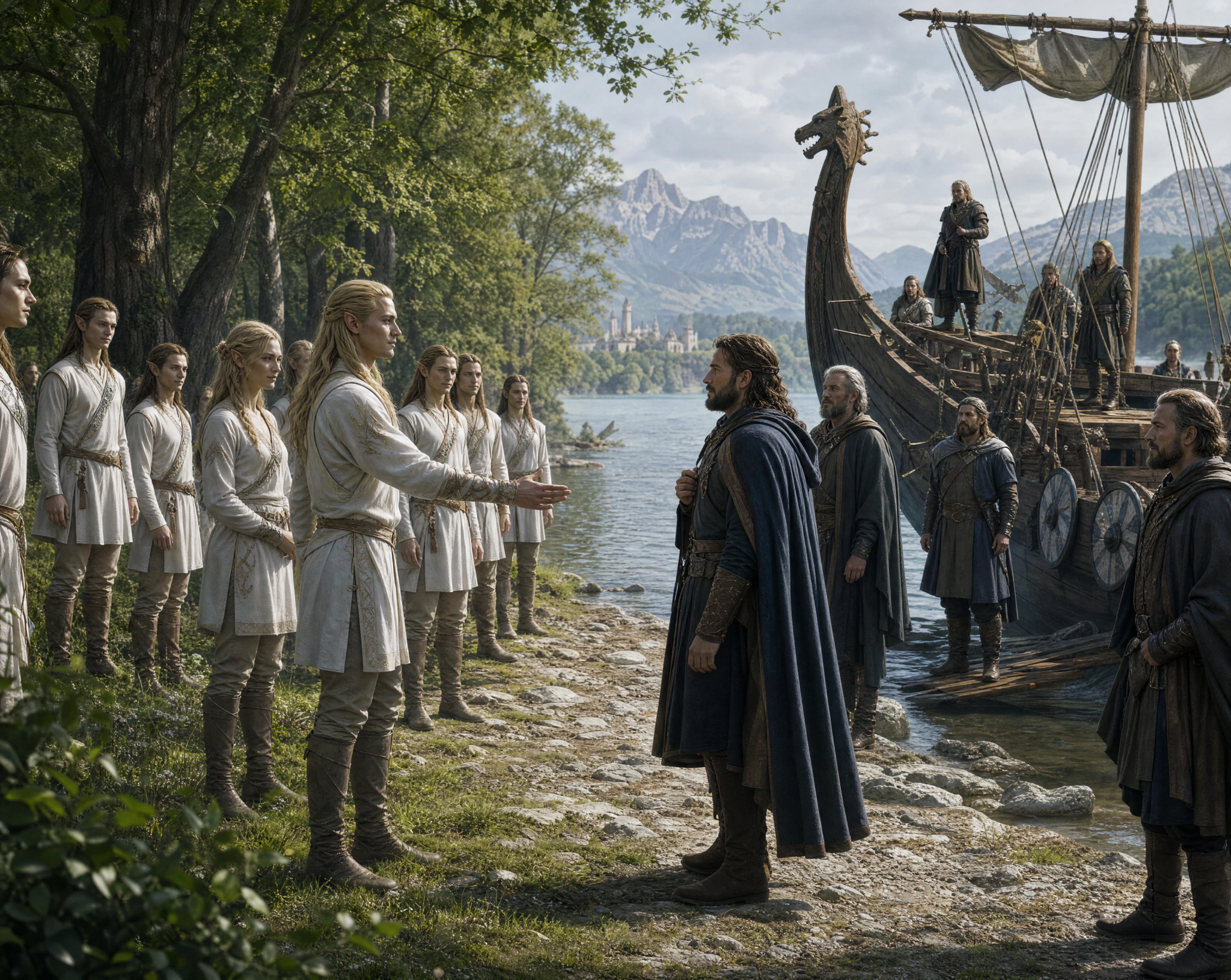
They are the border clan, and they live at the edges of the wood, where the rivers run out from under the Lyrian green and give way to the open roads, the lands of men and the kingdoms of stone.
They are the wood's voice in the world and the world's voice in the wood. The traders who carry elven work beyond the leaf-line are theirs, and so are the envoys sent when the clans must treat with a power outside the green. Warm hosts and sharp bargainers both, fluent in tongues no other elf troubles to learn, gracious to a fault and very hard to cheat — that is the Silver River. The long road of elven accord with the outside runs back through all of them to Maris: it was a half-daughter of this clan, Lady Yenna Jilian Tel'Nara, who at last won a lasting peace from the sun-folk of Aurelion, and it is the Silver River who have kept that peace tended ever since.
Not all the wood loves them for it. The Thornbound, who would wall the world out entirely, have never quite trusted the clan that keeps inviting it in, and the two have eyed each other across that disagreement since the circle first broke. It is the oldest quarrel in the wood after the matter of the fire, and the Silver River have given the same answer for as long as there have been clans to ask it. The wood, they will tell you, was never meant to be a wall. It was meant to be a place things could come home to.

Thornbound
They built no road; they built a guarding wall
And learned the one hard virtue: to remain
While seekers sought — and some of them did fall
The Thornbound held, and held, and held again
Thus we sing of Dornal Oaksworn and his people.
Aelvyr
Of the nine, Dornal is the one who did not believe in seeking at all. The others were each, in their way, a kind of seeker, but Dornal looked at the whole questing circle and distrusted every one of them from the first hour. He was stubborn, blunt, and immovable, in temper as in doctrine, and he said what he thought in as few words as it could be said.
His reasoning was the plainest of all the nine, and he never saw why it needed more. The Mother had given them shelter; given shelter one holds it, and does not go strolling along its edges to learn what lies past them. You do not, having just been dragged from a fire, wander back toward the heat to measure it. To Dornal every other reading of the gift was at best a restlessness and at worst an invitation to ruin, and he would not be argued out of it, not by anyone. He was the first to withdraw and the first to fortify, and he did not wait to be proven right before he built. He was the Farseer who would not be moved.
Principles
The creed of the Thornbound can be carried in one hand: the gift was shelter, so hold the shelter. Where other clans make a virtue of reaching — deeper, farther, brighter — the Thornbound make a virtue of staying put, which is harder than it sounds and far less admired. To them a thing is not proven by how far it reaches but by how long it lasts; the spark that flares and dies is nothing beside the oak that keeps its place through a thousand winters. Endurance is the whole of their faith. Endure, they will tell you, and you have already won.
From this comes the doctrine the rest of the wood finds hardest in them: the wall does not march. Their duty is to hold their own ground, and ground held is ground not abandoned — so the Thornbound do not carry their strength beyond their own borders, not for glory, not for alliance, not even for a righteous war. A wall that leaves its place to go and fight elsewhere is no longer a wall. It is only a thing that used to be one.

People
They are stocky, rooted, and closed — the most defensible of the clans and the least welcoming. Their warriors are made to hold rather than to dance, strength and endurance before speed and grace, and there is no line in the wood harder to break and none slower to give ground. They keep to their own fortified reaches behind their own borders, and they keep mostly to themselves; an outsider might pass a whole life near the Lyrian green and never once be let in among the Thornbound.
In manner they are their founder entire: blunt, stubborn, plain, slow to move and impossible to hurry, suspicious of the new, the foreign, and the clever. They make poor envoys and excellent walls. The wood respects them as its spine, for when something strikes at home, it is the Thornbound who hold the line while others scatter. They have never lost a fight on their own ground, and they have never once been moved to fight on anyone else's.
It surprises no one that they and the Silver River have never trusted each other. The two have stood on opposite sides of that argument since the circle first broke — the oldest quarrel in the wood after the matter of the fire. When everything else in the green has shifted and drifted and reached, the Thornbound are where they have always been, exactly where they were left.

Brightsong
A deed unsung is a deed undone, they say
So they sang on, through every age and fall
The bright, the grave, the names time wears away
And all the wood still keeps, it owes them all
Thus we sing of Cantarel of the Song and her people.
Aelvyr
The others heard the Mother in the deep and the distance — in root, in river, in stone and storm — but Cantarel heard her nearest the surface of things: in the lark at first light, in the color of a petal. She was luminous and open-minded and a little too much for a quiet room. Where the others heard doctrine, she heard a song.
And she understood a thing the rest of the circle were slow to learn — that the wood is always singing, and that to sing back to it is a way of loving the Mother no less true than any other. So she gave the elves their makers of beauty: the singers and the players, the painters and the poets, the troupes that carry a tune from grove to grove until the whole wood knows it by heart.
But the gift the Brightsong reckon her greatest, she did not set out to give. A people that keeps no scripture and raises no temple keeps its soul some other way, or loses it — and Cantarel was the first to see that for the elves that way would be the song. What is sung is kept. What is kept, lives. So she made of her clan the memory of the wood, and bound the whole of who we are into a music that can be carried in the mouth and handed down the leaf-falls. It is bound there still. She was the Farseer who would not let a thing be lost.
Principles
The Brightsong hold that beauty is neither a small thing nor a soft one. The loveliness of the wood is the Mother made plain to the eye, and to give it voice — in song, in color, in the turn of a told tale — is worship as surely as any rite kept in the deep groves. Delight, to the Brightsong, is the wood praising itself through the throats it was given.
But beneath the beauty runs the harder creed, and it is this: to be sung is to be kept, and to go unsung is to be lost. The elves keep no holy book, no graven law. What we are, we are because the Brightsong have sung us — name and deed and grief, the founding and the burning and the long green years between — down all the centuries, so that no elf wakes a stranger to himself. To the Brightsong there is a death deeper than the one the Gravekeeper tends. The body's end is only an ending of the tale; to pass out of the song is to have never been. And so they sing everything, and have made it their whole purpose that nothing of the wood should ever fall into that second, deeper dark.

People
They are the bright and wandering clan — singers and players, poets and painters, the troupes that move from grove to grove with a tune already half-finished. They are warm the way Cantarel was warm, generous and luminous and glad, and with the Silver River they are the face the outside world is gladdest to meet. The Brightsong fill the wood with voices, and the wood is the lovelier for it.
And if you would ask who keeps this very chronicle — who sang the nine, and the wood, and the burning, down all the long ages, that you might hear of them now — it is they. Every name set down here the Brightsong have carried in song since before there were pages to carry it. We remember the founding because the Brightsong would not let us forget it. That is their glory, and the wood owes them more for it than it has ever quite said.
Which is why the one time they have failed at their calling they have never forgiven themselves. For a clan that keeps everything to see something be lost in its entirety is heartbreaking. When it was resolved by the great powers that the Ninth must be gone from memory as they were gone from the world, the Brightsong felt it the most. They watched as verse by verse, name by name the music of a whole people thinned and faltered and failed, until even the singers could no longer find the tune. They will tell you, if you ask, that it is long done and long forgotten. The way they say it tells you it is neither.

Stormblade
They heard her in the hawk, the wind, the storm
The killing grace, the blade's unhurried art
They made of war a dance, of haste a form
And swore an oath that bound hilt to heart
Thus we sing of Sol’Vassar Stormdancer and his people.
Aelvyr
Of the nine, the others heard Mother in the gentle places, but Sol'Vassar heard her in the hawk's long stoop and the white cut of the storm, in the swift and terrible grace of a world that shelters its children and also hunts. He was sharp where the others were warm, exacting where they were patient, and he held grace to be a discipline and never a flourish — a thing earned in ten thousand strikes, not worn like a bright feather.
He did not flinch from what he heard, and that is the whole of his greatness. The wood that hides the fawn is the same wood that feeds the falcon; the Mother's mercy and the Mother's killing are one hand, not two. Where a softer elf would have turned from that and named it the wood's shadow, Sol'Vassar knelt to it and named it holy. So he gave the elves their warriors of the swift kind — not the weight that holds a wall, but the edge that ends a thing cleanly: the Wind Dancers, who move as the storm moves, and the Blade Dancers, fewer and finer, who are the edge itself. And he bound them, every one, with an oath — for a gift this sharp must be sworn to, or it turns in the hand that holds it. He was the Farseer who would not look away.
Principles
The Stormblade hold a thing the gentler clans would rather not say aloud: that the wood is not only kind. The Mother is the unfolding leaf, yes — but she is also the hawk that takes the dove from a clear sky. To pretend otherwise, the Stormblade say, is to love only half of her, and to be unready when the other half comes.
But the heart of their creed is this: the wrong is never in the killing. The hawk does no evil when it swoops; the storm is not cruel when it strikes. The wrong is in the cruelty, the waste, the strike that is more than enough — and most of all in the weapon turned against kin. So their whole discipline bends toward one end: the clean kill, the motion that is exactly itself and not one hair's breadth more. What looks to an outsider like beauty is only that economy seen from the side — the dancer is graceful because nothing in the dancer is wasted. And because a thing so sharp endangers the one who carries it no less than its mark, the Stormblade will not let it be carried to harm the wood and its people. The one who walks the path takes an oath: to wield the gift as the Mother's predator wields it, in need and never in appetite, with the grace and never the cruelty, bound always to the wood and to the discipline that earned the edge. The oath is the path. Strip it away and what remains is not a Dancer but only a killer. In all the years this song has run, the oath has held unbroken — and they do not let themselves imagine, even aloud, what manner of thing a forsworn blade would be.

People
They are the swift and exacting clan, and they are warriors as the Thornbound are warriors and not at all in the same way. Where the Thornbound are the wall that holds and will not be moved, the Stormblade are the wind that strikes and is already gone: dexterous, fast, honed to a fine and dangerous point. Their many are the Wind Dancers, who fight as the storm fights, everywhere at once and nowhere to be struck; their few, and their finest, are the Blade Dancers, the keenest edge the wood has ever set its hand to.
In their manner they are Sol'Vassar still — precise, sparing of word and motion and waste, devoted to grace and a little severe with anyone, themselves first, who falls short of it. To the Thornbound, who trust only what stays put, the Stormblade are all motion, and motion is the very thing a wall distrusts; to the Stormblade, the Thornbound are all stillness, complacency and missed opportunities for a strike. Yet between the two of them the wood is both held and defended, and neither has ever managed to do without the other.
This, in the end, is what the Stormblade are for, and what they would have you understand: that even the Mother's teeth can be sacred, and that there is a way to strike a thing that honors it — clean, swift, exactly enough, and purposeful. The falcon does not hate the dove. It only falls, perfectly, and is done.

Wildmane
They found her not in root but in the steed
The herd, the hunt, the warm and running kind
They raced for joy, and rode at reckless speed
And left the careful, rooted world behind
Thus we sing of Atel’Roen the Wild and her people.
Aelvyr
Of the nine, Atel'Roen is the one no roof could hold and no grove could keep. She was plainspoken and free-roaming, happiest with the wide sky over her and the open ground running out ahead, and least at home in the deep places the others loved. While they bent their heads to root and river and the hush of the canopy, Atel'Roen lifted hers and watched the beasts run — and that was her whole revelation, complete in a single glance: that the Mother is not only the green that stays rooted, but the warm and breathing thing that runs upon it.
She found the goddess in the living creature, in the herd and the hunt-bond and the trust that passes between a rider and the beast beneath her. So Atel'Roen ran with them and would not settle. She gave the elves their riders and herders and tamers, and she gave them, too, a way of loving the Mother that was nothing but gladness. She was the gladdest of all the nine, and her worship was a laugh and a gallop where the others' was a kneeling. She was the Farseer who would not be tamed.
Principles
The Wildmane hold that the Mother is not all stillness and depth. She is the herd at full run, and the hawk-quick turn of a startled deer, she made creatures to sit and slepp, yes, but she also made creatures to run, and a faith that forgets the second has only half remembered her. So where other clans seek her in what stays, the Wildmane seek her in what moves — and they are not ashamed that the seeking is also a delight.
The bond is the heart of it. Their mounts are not beasts of burden but kin: the great stallions and mares and stags and elk are won, never broken — tamed by friendship and never by mastery, in a trust that runs both ways and is held as sacred as any vow. And the running is the prayer. The Wildmane race, and they race for the pure mirth of the thing — not for need, not for any war, but for the wind in the face and the herd at the shoulder and the open ground unrolling ahead — and they will tell you, and mean it, that they are never more themselves, never freer, never nearer the Mother, than at a gallop. To them, a worship with no gladness in it is a worship that has lost the thread. The race is half their faith and the whole of their joy, and they pity the clans that have forgotten how to run.

People
They are the clan of the open ground — riders, herders, tamers, dwellers of the meadow rather than the deep wood, forever a little on the move and a little restless under any roof. They keep great herds and ride the beasts as partners and not as servants; and there are no hands in the wood surer with a living thing than theirs, nor any archers steadier from a running saddle.
In their manner they are Atel'Roen entire — plainspoken, open-hearted, quick to laugh and quicker to ride, the least solemn of all the clans. They measure one another by how a rider sits and how a rider laughs, and when they gather it is not to sit in council but to race: long wild contests of speed and skill and nerve across the open land, run for no reason but the gladness of running. Even their griefs they take at a gallop — where another clan would keep a still vigil, the Wildmane ride a sorrow out under the open sky until the worst of it is left behind on the wind.
The deep-wood clans find them rootless, and they find the deep-wood clans penned, and neither has ever quite talked the other round — but it is a fond bafflement, not a quarrel: the puzzlement of a people who could not bear to spend a life beneath one canopy regarding a people who could not imagine being without one. The Mother is in the wind as well as the root, in the gallop as well as the grove, and that joy, taken at speed with the herd at your shoulder, is no lesser a way of keeping faith than any kept kneeling in the dark.

Ashen Birch
Be still, so that the fire quells your heart
And watch the embers softly glow
Then stand! and dance! and let the fire's raging start
To make the room for things that grow
Thus we sing of Pyrinnean the Kindler and her people.
Aelvyr
Of the nine, Pyrinnean is the one too bright to look at directly. She was restless and certain and fierce, a flame in the shape of an elf, and where the others turned their gaze to the gentle things, she turned hers to the one thing the rest of the wood could not bear to look at at all.
She watched a wildfire cross a choked and dying wood and she did not flee it, and she did not mourn it. She watched. And she saw the thing the others would not let themselves see: that the wood came back. It rose from the black greener and stronger than it had stood in an age; the ash fed the soil, the heat cracked open seeds that would have opened to nothing else, the old and the dead and the strangling were cleared away so the young green could live. Fire is not only the enemy of the wood, Pyrinnean understood. It is also its midwife. The birch had been telling her so all along — the birch, that burns readiest of all the trees and is first to come back to the scorched ground.
Had she stopped there, the wood might in time have followed her. The tending of the green with fire, even that, the others might have come to understand. But Pyrinnean took the step that cannot be unmade. She did not only use the fire. She knelt to it. She honored it as a power worthy, a second devotion beside the Mother, an altar raised to the flame in the very heart of the shelter that was built to keep the flame out. That kneeling is the whole of why the Ashen Birch stand where they stand. She was the Farseer who knelt to the fire.
Principles
The Ashen Birch hold a truth that no elf, can entirely deny: that the same fire which takes the wood is the fire which renews it. They are the only people in all the world who have learned to turn flame to growth — to wield it not as a weapon but as a blessing, a clearing of the choked and the dead so the green may live again. Ash is the richest soil, they say; some seeds will wake to nothing but heat; the wildfire is only the Mother's own hand, passing through the wood to make it young. In this they are not wrong.
They do not stop at that. They hold that fire is not merely a servant of the green but a power in its own right — old and primal — and they worship it. To the Ashen Birch this is no betrayal. Fire is part of the Mother's world, they say, part of her renewing, and to honor it is only to honor the whole of what she made. But to every other clan it is the one unforgivable thing. We crossed under her leaf with ash on the heart and the fire of a dying world at our backs, and the wood is the very thing that saved us from it. So to the rest of the elves, fire is not an idea to be weighed. It is the face of the ruin we were carried out of — and a clan that turns and raises an altar to it is honoring the destroyer, lifting up the very thing the Mother shut the green against. The Ashen Birch answer that we have never forgiven the fire for an old wound, and so have never once seen it true, that we were mistaken in our grief and have feared the flame so long we can no longer tell its renewing from its ruin. Neither side has ever moved the other. It is the oldest quarrel in the wood.

People
They are the clan that stands apart. They keep two devotions where every other keeps one, and that second devotion sets a distance between them and the rest of the green. They are not cast out — they are elves, and they love the Mother as truly as any — but they are not gathered close either. They will not douse the fire to be welcomed back.
They dwell in the drier reaches and the burning margins, the parts of the wood that take the flame and come back green, and in their bearing they are what Pyrinnean was — bright, certain and fierce. There is no warmth of the Silver River's kind in them and none of the Wildmane's gladness; theirs is a hotter, harder thing, a banked intensity that the gentler clans find difficult to sit beside.
The wound runs deepest, as it has from the very first, between the Ashen Birch and the Verdant Heart. Pyrinnean and Ornigal woke side by side in the sheltering-years and of all the circle they should perhaps have been the closest. Instead they broke, once and forever, upon a single question, and the wood has stood on the two sides of that question ever since. It has never been answered. And yet there come years when an old grove chokes and dies, and a fire passes through it, and the next spring it returns greener than the wood has been in living memory. And in that one moment, before he remembers himself, the old druid in the green looks on it and understands, exactly and completely, what it was that Pyrinnean saw.

Mirrorveil
You follow the moon down a toadstool ring
And come back laughing, and would not say
What waits you there at the edge of every thing
You only grin, and look away
Thus we sing of Tektakri the Laughing One and their people.
Aelvyr
Of the nine there is Tektakri, the Laughing One. Sometimes he. Sometimes she. Sometimes a third thing the tongue has no hook to hang a name on. Tektakri heard the Mother's sister — heard Syl Miravel, the Moon, in the silver between the leaves — and went walking into the faerie rings towards folly or mirth.
And came back.
Came back laughing. Came back with dew in the hair and a moth on the sleeve, with a grin you would not believe and a secret that would not leave; came back grinning like a fox in a henhouse who has decided, today, against the hens. What Tektakri saw at the edge, Tektakri never said — or said nine ways, all true and none the same. You do not pin the Laughing One to a page. The page comes back blank, or comes back changed, or comes back with a small rude drawing where the words had been. Tektakri is the Farseer who would not hold still.
Principles
You cannot set down the principles of the Mirrorveil, because they keep none that hold — or they keep all of them at once, each one upending the last, and somehow every one of them true. They follow the wild where it thins into the Otherworld: moonlight and glamour and the turn of luck, the door in the hill, the ring in the grass, the part of the wood where the ordinary rules do not pass. The Mirrorveil lean hard toward the Moon and the Fey, and they are not called pagan for it — though by rights you might think they should be. The difference is family. The Moon is the Mother's own sister, and the Fey live inside the wild and not outside it. the fire the Ashen Birch honor is the thing that unmakes the green, but the moon the Mirrorveil chase is only the green's odd cousin, up too late and laughing in the dark. One crossed a line. The other only crossed a stream — and then crossed it back, and sideways, and turned the whole stream into a dream.

People
They are the smallest of the clans and, by a wide margin, the strangest — here and then not here, counted at a dozen one season and a hundred the next and no one quite sure which was the lie. They turn up: out of a ring, out of a tune, out of the wrong side of the moon. Their warriors are rarer than that, and the whole of the rule is this — there almost never is one, and when there is one, you very much wish there were none. Blade and spell and sheer ridiculous flair, troops so few and so fine the other clans half-swear they were never there. They arrive like a joke and leave like a wound.
And here, only here, the laughing stops. For of all the clans still standing, it is the Mirrorveil who walked nearest the edge the Ninth went over. The Mirrorveil will neither grant this nor deny it. They will offer you a riddle, or a mushroom, or a perfectly straight answer to a question you never asked — and by the time you have worked out which, they are three groves away, and laughing, and it is, once again, the wrong moon.
